

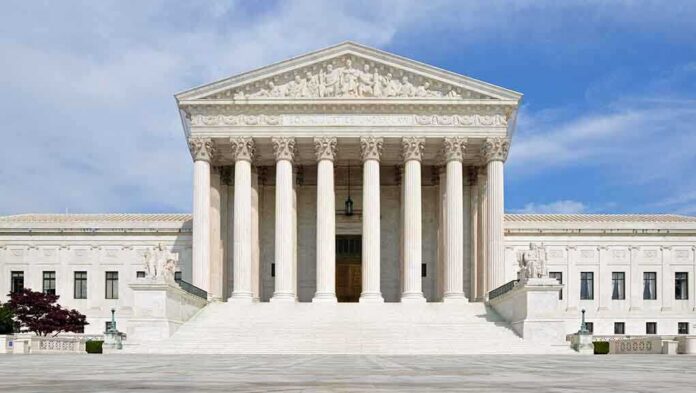
Pete Buttigieg said on national television that Congress should consider adding Supreme Court justices because the Court has become “a nakedly partisan institution,” turning a long-simmering fight into a live reform push.
Story Highlights
- Pete Buttigieg urged reforms that could expand the Supreme Court, citing lost legitimacy.
- Opponents warn “court-packing” would set a dangerous precedent and deepen partisanship.
- Polling shows most Americans oppose adding justices, even many Democrats are split.
- History shows Congress can change the Court’s size, but true “packing” fights are rare.
What Buttigieg Said And Why It Matters
Pete Buttigieg used a Meet the Press interview on September 13, 2026, to argue the Supreme Court has become “a nakedly partisan institution” and that Congress should consider changing its size as part of broader reforms. Buttigieg tied the idea to restoring legitimacy, not adding seats for its own sake. His comments move a once fringe debate into the mainstream. They also signal a strategy many Democrats now voice after rulings they view as blocking voting, abortion, and climate policies.
Supporters say Congress has the legal power to change the Court’s size and has done so before. They also argue that term limits, ethics rules, or rebalancing could lower the temperature. Buttigieg framed the goal as repairing trust. He echoed a theme that the Court’s public standing has slid in recent years. The fight is not only about cases. It is about whether Americans still see the Court as a fair referee, or as one more political team wearing robes.
The Core Clash: Legitimacy Versus Precedent Risks
Opponents warn that expanding the Court to address outcomes today invites a spiral tomorrow. The Presidential Commission on the Supreme Court recorded critics’ concerns that expansion would weaken independence, hurt legitimacy, and set a precedent for each new majority to add seats until it gets the decisions it wants. That fear crosses party lines when power shifts. It reflects a shared worry that institutions already look captured by insiders who protect their own.
Public opinion is another hurdle. A Brookings summary reported that, in 2020 polling, nearly three-fifths of Americans opposed adding justices, and even among committed Democrats, support was about even. Those numbers make sweeping change hard. They also suggest many citizens distrust both parties’ motives. People on the right fear a super legislature in robes. People on the left fear a locked-in bench that thwarts lawmaking. Both fear a government serving the powerful over the public.
What Reform Could Look Like — And The Trade-offs
Congressional researchers have mapped ideas ranging from term limits to changing the Court’s size and even mandating ideological balance on the bench. Some scholars argue “balanced bench” or “lottery” models would lock in partisan identity, which could cement the very labels reform is supposed to erase. Every option carries trade-offs. Term limits may cool lifetime stakes but need a careful plan. Expansion may reset the Court but risks a cycle of retaliation.
History gives cover and caution. Congress has changed the number of justices several times, and the Constitution leaves that number to statute. The Presidential Commission noted Congress’s broad authority on size, rooted in text and history. Still, episodes branded as “court-packing,” like 1937, scar the public memory. They read as raw power plays, not neutral fixes. That is why today’s push forces a tough test: can reform strengthen trust without looking like payback?
Why This Fight Resonates Now
Americans across the spectrum see a government that misses real problems. People watch prices, crime, border strain, and culture wars while leaders trade blame. The Court debate taps that mood. Buttigieg’s case says the Court now tilts like a political branch, so reform is needed to restore fair rules. Critics respond that expansion would make the Court more political and turn nine referees into many lawmakers in robes. The shared fear is the same: a system rigged by elites.
That is why process matters. Clear goals, narrow tools, and public buy-in will decide whether any change adds stability or sparks new chaos. If leaders chase short-term wins, trust will sink further. If they set rules that bind both parties, some confidence might return. The stakes reach beyond one term or one case. They reach into whether Americans can again believe that the rules are fair, the umpires are neutral, and the game is not fixed from the start.
Sources:
thegatewaypundit.com, legalinsurrection.com, nbcnews.com, youtube.com
© boldfrontnews.com 2026. All rights reserved.