
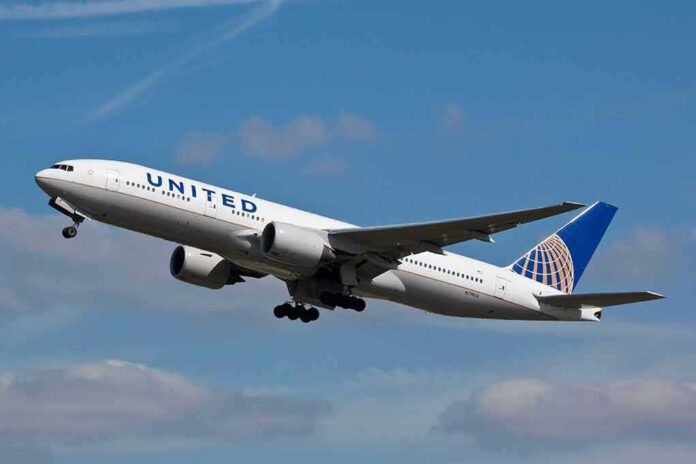
A United flight to New Orleans sent a hijack alert after a passenger said he had a bomb and tried to reach the cockpit, but the plane landed safely and the suspect was arrested, officials said.
Story Highlights
- United Flight 2174 sent a hijack alert after a midair bomb claim and cockpit approach.
- Deputies arrested the passenger after landing and booked him on felony charges.
- Reports say the suspect had been deported twice before and later released by a judge.
- Most aviation bomb threats prove false, but airlines must treat each as real.
What Happened Onboard United Flight 2174
United Flight 2174 from Newark to New Orleans reported a serious in-flight disturbance late Monday. Jefferson Parish officials said a 34-year-old passenger told crew he had a bomb and moved toward the cockpit area, which led pilots to send a hijack alert. The jet continued to New Orleans and landed without injuries. Deputies met the aircraft at the gate, detained the man, and began a criminal probe tied to the alleged threat and disruption of the flight.
Deputies booked the suspect for communicating false information of planned arson and for terrorizing, which are felony-level offenses under local law, according to news reports that cited the sheriff’s office. Officials said the arrest occurred without incident after the aircraft reached the gate. United Airlines said crew followed security procedures meant to protect passengers and the flight deck when a potential threat occurs. No explosive device was found, based on available reporting.
What Authorities Say About The Suspect
Media reports, citing the Department of Homeland Security and prior immigration records, identified the man as Rony Alexander Gomez-Alberto. Coverage said he had been deported from the United States twice and was later released by a judge in a separate immigration matter years before this flight. Those reports describe multiple earlier encounters with border officials. Authorities have not announced federal charges related to Monday’s flight as of this writing.
Officials in Jefferson Parish described the onboard behavior as irrational and threatening. Flight attendants reported the bomb claim to the pilots, who then coordinated with air traffic control for priority handling. Airline and airport responders prepared for a possible emergency upon arrival. Standard procedures place the aircraft at a remote or controlled gate, where law enforcement boards first to secure any suspect and assess immediate risk to others on board.
Why Airlines Treat Every Threat As Real
Airlines and airports treat low-frequency but high-impact threats as real until proven false. Global aviation guidance supports this approach because one missed signal can be catastrophic. Reuters reported that the vast majority of bomb threats end up being false alarms, but responders still must mobilize to check the aircraft, luggage, and passengers. That process can disrupt schedules and cause diversions, but it is designed to protect lives first.
Recent waves of hoax threats in Europe show how disruptive this pattern can be. Officials there described dozens of alerts in a few days, none of which revealed explosives. Even so, flights were diverted, some got military escorts, and passengers underwent extra screening. Experts warn that repeated hoaxes can mask real danger or breed complacency. The United incident fits that broader security posture that takes any bomb claim at face value until cleared by authorities.
Rising Pressure From Unruly Passenger Incidents
The Federal Aviation Administration (FAA) has tracked a surge of unruly passenger cases in recent years. FAA material reported 2,102 such incidents in 2024. Security planners also track threat levels that include approaching or attempting to breach the cockpit. The combination of more disruptive behavior and persistent hoax threats places crews under high stress and forces rapid choices to protect the flight deck and passengers.
✈️ United flight triggers hijack alert after passenger claims bomb threat.
A suspect attempted to storm the cockpit on a flight bound for New Orleans.
Authorities arrested the individual following the mid-air security incident.#AviationSafety #UnitedAirlines pic.twitter.com/D8K8y4RPaD— WorldScopeX (@WorldScopeX2) November 11, 2026
Security planning also focuses on the moments when the cockpit door is opened. Analyses have long flagged that brief window as a vulnerable point that requires tight crew coordination and barriers. Airlines have moved to add more layers, such as secondary barriers on some aircraft, to slow any intruder and give pilots time to lock down. These steps help explain why flight crews react fast when someone moves toward the door after making a threat.
Why This Case Touches A Nerve
This case blends two issues that anger many Americans. People worry about flight safety and want strict responses to threats, even if they turn out false. People also want immigration rules followed and enforced with care and consistency. Reports that the suspect had past deportations and a judge-ordered release are drawing fresh questions about how the system works when public safety is at stake, and how to keep dangerous behavior off airplanes.
What To Watch Next
Local prosecutors will decide on state charges tied to the bomb claim and cockpit approach. Federal agents may review whether to add charges for interference with a flight crew or making threats. United and the Transportation Security Administration will review crew actions against policy. If confirmed, the suspect’s prior immigration history will likely enter the political debate. For now, officials say the threat was false, the crew acted quickly, and all passengers made it home safe.
Sources:
en.royanews.tv, news.meaww.com, timesnownews.com, dailymail.com, kpel965.com, faa.gov
© boldfrontnews.com 2026. All rights reserved.