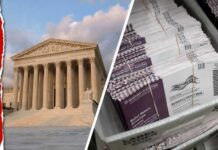

Missouri’s highest court froze a new congressional map weeks before the general election and said voters—not politicians—must decide if it stands.
Story Snapshot
- The Missouri Supreme Court said a voter referendum on the map was sufficient and timely.
- The court blocked the new map from taking effect unless voters approve it in November.
- The 2022 congressional districts will govern the 2026 general election.
- Judges relied on Missouri Constitution language allowing a referendum on “any act” of the Legislature.
What The Court Decided And Why It Matters
On September 3, 2026, the Missouri Supreme Court ruled that a citizen referendum to challenge the Legislature’s new congressional map was valid and timely. The court said the Secretary of State was wrong to reject the petition. Judges held that the map cannot take effect unless voters approve it on the November ballot. The decision means the 2022 post-census districts control this year’s congressional races. The ruling places direct democracy over a mid-decade redraw for now.
Judges grounded the ruling in Article III of Missouri’s Constitution. That section gives people the power to accept or reject “any act” of the General Assembly by referendum, unless an exception applies. The court concluded the redistricting act was subject to that process. Reporters quoted the court’s line that the petition was “sufficient and timely” and the secretary “incorrectly concluded otherwise.” That language sets a clear legal trigger tied to voter signatures, not political timing.
How This Interacts With Earlier Court Decisions
The same court earlier upheld the Legislature’s authority to pass the map, which caused confusion for many people. In May, the court signaled that if a proper referendum qualified, the law could be suspended from taking effect. That made the petition’s timing and sufficiency crucial. This week’s decision followed that path. It did not erase the Legislature’s vote. It said the map is not effective law until voters approve it. The prior 2022 lines therefore remain in force for November.
A Cole County judge and the Secretary of State had previously said congressional maps are not subject to the referendum process. They leaned on state and federal arguments about elections powers. The Missouri Supreme Court disagreed. The court’s reading matched a century of state practice that lets people check the Legislature unless a clear constitutional exception applies. That choice draws a firm line between passing a law and putting it into effect before voters can weigh in.
Political Stakes And The Voter Experience
President Trump backed the new map and said it would likely add another Republican seat. Republican leaders argued lawmakers could redraw districts mid-decade. Democrats and voting rights groups said the map favored one party and should face a public vote. The court did not rule on partisan fairness this time. It focused on process and voter power. The decision avoids changing districts after ballots lock, yet it also honors signatures gathered to test the map at the polls.
Today's Missouri Supreme Court rulings ignite nothing short of a Constitutional crisis. No court has ever rejected a congressional map that had already been used in an election, as the Missouri First Congressional Map was in the August primary.
We may have lost the battle today,… pic.twitter.com/kG3Z4MV8dh
— Secretary of State Denny Hoskins, CPA (@DLHoskins) September 4, 2026
Missourians now face a two-track fall. They will vote in districts drawn in 2022, and they will separately decide whether to approve the Legislature’s newer map. Election officials must finalize ballots quickly and explain the difference between the congressional races and the referendum question. Clear communication will matter. Confusion can feed mistrust on both sides. The court’s remedy aims to protect votes already cast in primaries while still giving people a say before a new map governs future elections.
Why This Fits A Bigger National Pattern
States can redraw congressional lines between censuses. The United States Supreme Court allowed mid-decade redistricting in a 2006 case involving Texas. The main fights today turn on state constitutions and direct democracy rules. Missouri’s clash shows how timing rules, emergency clauses, and ballot access can decide whether voters can block a map before it shapes power in Washington. Other states have seen similar showdowns, with courts refereeing who decides and when.
For many Americans, this episode feeds a common worry: the system serves insiders first. Conservatives see courts and activists undoing legislative action. Liberals see politicians drawing maps to lock in power. The court’s decision does not settle those debates. It does set a process test that both sides can understand. If citizens meet the bar for a referendum, their vote comes next. That is a simple standard that checks power, whichever party holds it.
What To Watch Next
Watch for any emergency appeals that try to reinstate the new map before November. Also watch how the Secretary of State explains ballot wording and voter education. Expect heavy spending to shape public opinion on the referendum. If voters approve the map, it will take effect later. If they reject it, lawmakers face pressure to try again under tight timelines. Either way, the court put the choice where the Constitution says it belongs: with the people.
Sources:
nbcnews.com, cnn.com, townhall.com, news.bloomberglaw.com, washingtonexaminer.com, usnews.com, nytimes.com, kmbc.com, nypost.com, thegatewaypundit.com
© boldfrontnews.com 2026. All rights reserved.