
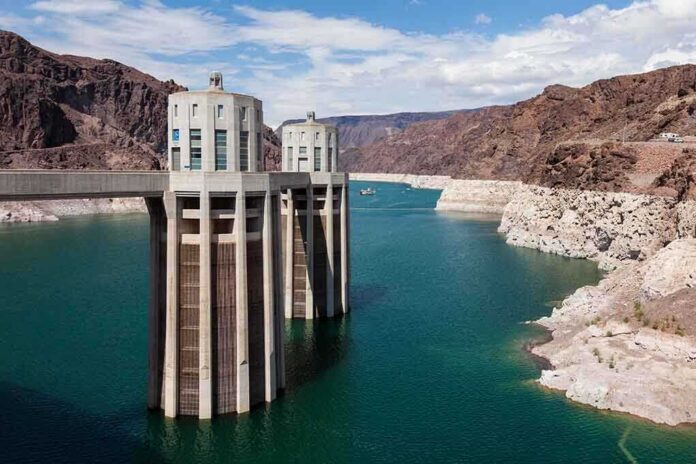
Lake Mead has fallen to a new record low, deepening a water crisis that now touches millions of people across the Southwest.
Quick Take
- Lake Mead dropped to **1,040.5 feet**, breaking the previous record low set in 2022.
- The reservoir helps supply water to about **20 million people** in the Southwest and West.
- Officials and researchers tie the decline to long drought, rising demand, and climate stress across the Colorado River Basin.
- The shrinking lake keeps pressure on Hoover Dam, water users, and regional power planning.
Record Low Deepens Pressure on the Colorado River
Federal data reported by major news outlets shows Lake Mead fell to 1,040.5 feet on Thursday, setting a new record low and slipping below the previous mark from July 2022. The lake is the largest reservoir in the United States, and this latest drop confirms that the basin has not found a stable bottom. For cities, farms, and utilities that depend on it, the trend keeps raising the same hard question: how much longer can demand outrun supply?
The scale matters because Lake Mead is not a remote water body with local impact. It is a core part of the Colorado River system and helps supply water to roughly 20 million people in the Southwest and West. Other reporting says the reservoir is also near levels that can strain Hoover Dam hydropower planning, which makes the problem bigger than a drought headline. It affects drinking water, irrigation, electricity, and the daily budget of fast-growing desert cities.
Why the Lake Keeps Falling
The decline fits a pattern that has been building for years, not a one-time shock. NASA and other research-based coverage describe Lake Mead as part of a long downward trend tied to persistent drought and growing human demand. Weather and climate reporting also points to dry conditions that have lasted since the 2000s, with reduced snowpack and weaker runoff adding more strain. In plain terms, the river is bringing in less while the region keeps asking for more.
That mismatch has become one of the clearest signs of stress in the American West. The lake has hovered at very low levels for years, and recent reports show it was already close to its earlier record before this new drop. The Bureau of Reclamation’s elevation history also shows repeated low points over time, which means the current crisis is part of a longer balance problem, not a sudden collapse.
What the New Low Means Now
The new record low will likely keep focus on how water is shared, stored, and priced across the Colorado River Basin. That debate has grown sharper because Lake Mead sits at the center of a system serving states that depend on every inch of reservoir height. The latest milestone also reminds both parties that Americans often hear promises about long-term planning, but the physical system keeps sending a different message: the math still does not work.
8/8/26. US. Lake Mead, the nation’s biggest reservoir, hits lowest level on record. The milestone is yet another sign of the escalating water crisis on the Colorado River, which scientists say is worsened by climate change. https://t.co/CLbVHRtNAr
— andrew watterson (@aew1aew1) August 8, 2026
For many readers, the story lands because it cuts across familiar frustrations. People who blame Washington see a federal system that has managed scarcity poorly for decades. People who focus on climate see a warming and drying West that keeps tightening the squeeze. Either way, the latest low at Lake Mead shows a basic truth: if supply keeps shrinking and demand does not, the crisis only gets harder to escape.
Sources:
independent.co.uk, cnn.com, usatoday.com, abcnews.com, nypost.com, climate.gov, abcnews.go.com, smithsonianmag.com, science.nasa.gov
© boldfrontnews.com 2026. All rights reserved.