

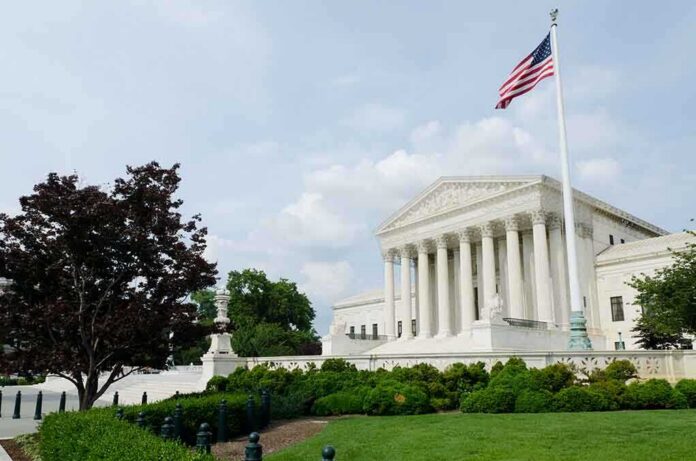
The Supreme Court just handed federal bureaucrats a blank check to deliberately refuse service to Americans without legal consequence, crushing accountability in a 5-4 ruling that shields postal workers even when they intentionally withhold your mail.
Story Highlights
- Supreme Court ruled 5-4 on February 24, 2026, that USPS cannot be sued under federal tort law even for intentional mail nondelivery
- Texas landlord Merly Konan alleged postal workers deliberately refused to deliver her mail due to racial bias, harming her rental business
- Ruling expands federal immunity beyond negligence to cover deliberate misconduct, blocking accountability for intentional wrongdoing
- Small businesses, newspapers, and mail-dependent industries lose legal recourse when federal employees deliberately fail to deliver
Supreme Court Shields Deliberate Misconduct
The Supreme Court reversed a Fifth Circuit decision on February 24, 2026, ruling that the Federal Tort Claims Act bars lawsuits against USPS for any mail delivery failure, regardless of intent. Justice Clarence Thomas authored the majority opinion, determining that the FTCA’s postal exception covers all nondelivery incidents, whether accidental or deliberate. Texas landlord Merly Konan had sued after postal workers allegedly refused to deliver her mail due to racial discrimination, causing business losses and emotional distress. The ruling overturned the Fifth Circuit’s narrower interpretation that limited immunity to negligent acts.
Government Immunity Trumps Individual Rights
The decision centers on 28 U.S.C. § 2680(b), a 1946 provision excepting claims “arising out of the loss, miscarriage, or negligent transmission of letters or postal matter.” The majority interpreted this language to shield USPS from all mail-related liability, even when employees purposefully withhold delivery. Justice Sonia Sotomayor led a four-justice dissent joined by Justices Kagan, Gorsuch, and Jackson, arguing the exception should apply only to negligence, not intentional torts. This interpretation means federal workers can deliberately deny service without victims having legal remedy through tort claims.
Expanding Federal Overreach at Citizens’ Expense
This ruling exemplifies the dangerous expansion of sovereign immunity that insulates government bureaucrats from consequences. Americans who depend on mail for business operations, rental income, or critical communications now have zero recourse when postal employees intentionally sabotage their delivery. The Federal Tort Claims Act was designed to waive immunity for government misconduct, yet the Court’s broad reading creates a carve-out that protects deliberate wrongdoing. This undermines the principle that government servants must be accountable to the citizens they serve, replacing it with unchecked federal authority.
Economic Impact on Main Street America
Small businesses and newspapers face heightened risks from this immunity expansion. The National Newspaper Association criticized the ruling, with Chair Martha Diaz Askenazy warning it “weakens accountability and puts newspapers at risk.” Publications relying on mail circulation lose legal options when postal workers fail to deliver, directly threatening revenue and operations. Landlords like Konan who depend on mail for tenant communications and business documentation face similar vulnerability. The ruling creates perverse incentives where postal employees face no legal consequences for deliberate service denial, potentially degrading mail reliability nationwide.
The Postal Service's Recent Supreme Court Win Is Bad News for Government Accountabilityhttps://t.co/0zvWIh5DDo
— José Colón (@JoseEColon) February 26, 2026
The case now returns to the Fifth Circuit, where Konan’s tort claims against USPS remain barred. While she may pursue individual employee lawsuits outside the FTCA framework, this path offers limited practical remedy for most Americans facing similar federal misconduct. The decision signals troubling judicial willingness to prioritize bureaucratic protection over citizen rights, expanding government immunity at the expense of individual accountability. Conservative principles demand limited government answerable to the people, not shielded federal employees operating above the law with deliberate impunity for harming Americans.
Sources:
Tucson Sentinel – Supreme Court Rules on USPS Immunity
Faegre Drinker – Supreme Court Decides United States Postal Service v. Konan
Reason – The Postal Service’s Recent Supreme Court Win Is Bad News for Government Accountability
SCOTUSblog – Court Holds That U.S. Postal Service Can’t Be Sued Over Intentionally Misdelivered Mail
National Newspaper Association – NNA Disappointed With Supreme Court Decision in USPS v. Konan
Supreme Court Official Opinion – United States Postal Service v. Konan
FreightFlowAdvisor – The Supreme Court Just Gave USPS a Free Pass