

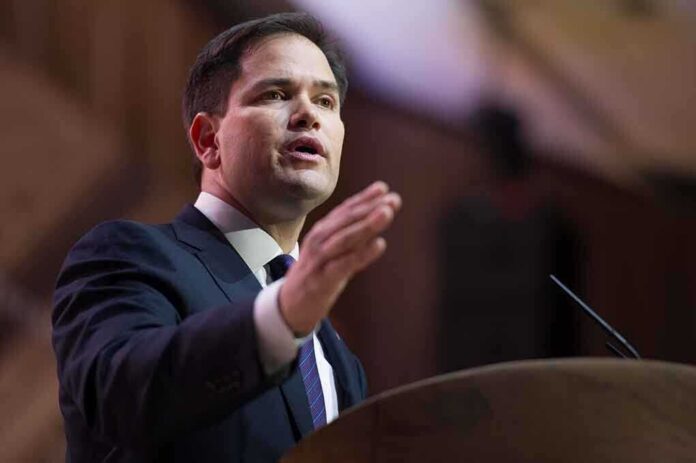
AOC tried to undercut America’s top diplomat on a world stage—only to spotlight how the Left keeps reducing national security to culture-war talking points.
Quick Take
- Secretary of State Marco Rubio received a strong reception at the 2026 Munich Security Conference after defending the U.S.-Europe alliance and rejecting “managed decline.”
- Rep. Alexandria Ocasio-Cortez attacked Rubio’s message as “cultural nostalgia,” arguing alliances must deliver material benefits and focus on inequality.
- Rubio’s remarks emphasized realism on migration and climate narratives while framing the West’s future as a strategic choice, not an inevitability.
- The clash highlighted how U.S. partisan fights are now playing out in front of allies who want stability and clarity from Washington.
Rubio’s Munich Message: Alliance First, Decline Rejected
Secretary of State Marco Rubio used the Munich Security Conference on February 14, 2026 to argue that the U.S.-Europe partnership remains central to Western security and prosperity. Reporting on the event described a standing ovation after Rubio warned against what he called “dangerous delusions” surrounding migration and climate debates and pushed back on any expectation of “managed decline” for the West. The core theme was reassurance: America is still committed, but expects seriousness about shared challenges.
Rubio’s framing also matters politically at home. Many conservatives see transnational bureaucracy, open-border pressure, and elite consensus-building as vehicles for eroding sovereignty—often without democratic accountability. In that context, a pro-alliance speech only works if it also signals limits: strong partnerships, yes, but not at the expense of national self-government or the safety of American communities. The available reporting does not include a direct Rubio rebuttal to critics, but it does emphasize his goal of unity.
AOC’s Counterattack: “Cultural Nostalgia” and Class Politics
Rep. Alexandria Ocasio-Cortez responded the same day from a separate Munich panel focused on populism. She criticized Rubio’s address as substance-light and rooted in “cultural nostalgia,” contending that alliance arguments should be grounded in tangible benefits for ordinary Americans and Europeans. In the same set of remarks, she tied her critique to longstanding progressive concerns about inequality, immigration rhetoric, and enforcement policies linked to ICE. Her comments were widely circulated online, adding fuel to the partisan split.
AOC also connected Rubio’s style of alliance rhetoric to broader Trump-era controversies, including recurring headlines about U.S. pressure on Greenland and sharp immigration enforcement messaging. The research materials summarize her position as arguing that culture-focused appeals do not resolve working-class stress or the political backlash that follows. What’s missing from the available sources is any detailed policy alternative from her beyond general calls for wealth-tax style measures and “working-class-focused” economics, leaving the debate largely at the level of competing narratives.
Why This Argument Landed Differently in Europe
Munich is not a normal cable-news set; it is a high-signal venue where foreign leaders and security officials measure U.S. coherence. The research notes that Rubio’s speech achieved a rare moment of unity at the conference, which matters because Europe is tracking U.S. follow-through on deterrence challenges involving Russia, China, and Taiwan. When an American lawmaker publicly frames the secretary of state’s alliance case as sentimental branding, allies are left wondering which America will speak tomorrow—and which one will govern.
That uncertainty is not abstract. The same research points to rising populism and geopolitical volatility as the backdrop for MSC2026. In that environment, allies want predictable commitments, while Americans want leaders who defend the national interest without slipping into globalist blank-check policies. Rubio’s argument, as described, attempted to thread that needle: affirm the alliance, but demand clear-eyed realism about migration and other pressure points. AOC’s critique, by contrast, centered on domestic economic grievances.
Conservative Takeaway: Security Debates Can’t Be Reduced to Slogans
Conservatives are right to be wary when foreign policy gets repackaged as moral signaling—whether it is “woke” posturing abroad or bureaucratic pressure at home that dilutes constitutional self-rule. The research also highlights conservative commentary portraying AOC’s foreign-policy posture as unserious, including references to past moments where she was criticized for evasiveness on hard security questions like Taiwan. The available materials, however, largely reflect media analysis rather than new documentation, so readers should treat broad character judgments cautiously.
AOC "TAKES A SWING" AND MISSES AT RUBIO'S SPEECH
The @charliekirk11 also points out she does not know where Venezuela actually is in her recent interview – "just because the nation is below the equator." 👀@AndrewKolvet pic.twitter.com/OwuwIifCzb
— Real America's Voice (RAV) (@RealAmVoice) February 16, 2026
Still, the basic tension is real and visible in Munich: one side argues alliances must be defended as strategic necessities in a dangerous world; the other argues that economic inequality and domestic policy grievances should be the organizing lens. Rubio’s approach fits a traditional security framework—deterrence, stability, and shared purpose—while also warning against policy fantasies on migration and climate. AOC’s approach channels progressive class politics, but the research provides limited specificity on how that would strengthen deterrence now.
Sources:
Secretary of State Marco Rubio Delivers ‘Diplomatic Miracle’