

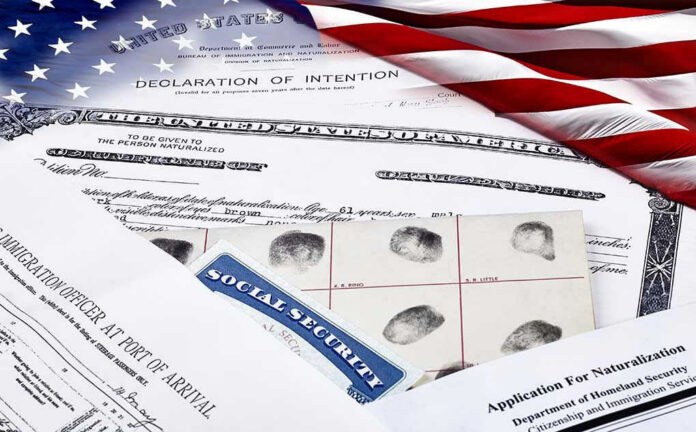
A new Department of Homeland Security plan would nearly double citizenship application costs while ending most breaks for low‑income immigrants, raising sharp questions about who should pay for America’s vetting system.
Story Snapshot
- DHS proposes raising the core citizenship form fee to $1,330 paper and $1,280 online, a 75–80% jump.
- The plan would end reduced fees and waivers for most low‑income applicants, keeping exemptions only for U.S. service members.
- DHS says current fees no longer cover full vetting and security costs under Trump’s tougher screening rules.
- Critics warn the “beneficiary pays” model could price out many legal immigrants from finishing the path to citizenship.
DHS Plan: Big Jumps In Citizenship Costs
The Department of Homeland Security has released a proposed rule that would sharply raise the cost of the main citizenship application, Form N‑400. Under the draft, the paper filing fee would climb from $760 to $1,330, a 75% increase, while the online fee would jump from $710 to $1,280, an 80% increase.[3] These changes come just two years after naturalization fees were last updated in 2024 to the current levels.[7] The rule also raises fees for appeals of denials, with Form N‑336 jumping from $830 to $1,475 on paper.[4]
DHS estimates the higher fees would generate hundreds of millions of dollars more per year from roughly 1 million naturalization applicants.[1] Agency officials say that money is needed to pay for more intense screening, background checks, and interviews that have expanded under President Trump’s executive orders on immigration vetting.[3] In plain terms, the administration wants the citizenship process to be self‑funded, with applicants covering the full cost instead of taxpayers or other visa categories subsidizing it.[2]
From “Shared Costs” To “Beneficiary Pays”
In 2024, the government raised naturalization fees modestly but also expanded help for low‑income families, adding a 50% reduced fee of $380 and preserving full waivers for the poorest applicants.[7] The new Trump‑era proposal would reverse that course. DHS explicitly calls this shift a “full‑cost, beneficiary‑pays” model where the person applying for citizenship pays the entire processing bill.[2] The agency argues current fees do not fully cover the cost of “thoroughly adjudicating” applications, including stronger vetting, social‑media checks, and other security steps now used for green cards and naturalization.[4]
Supporters inside the administration frame this as basic fiscal responsibility. They note U.S. Citizenship and Immigration Services faces a large funding shortfall for naturalization work and say cross‑subsidizing citizenship from other immigration fees is unfair.[2] They also stress that U.S. citizenship is the most significant immigration benefit the nation offers, with full voting rights, passport access, and long‑term security, so the government must spend enough to protect that status from fraud and abuse.[4] From that view, higher fees are a tool to sustain tough vetting without growing the federal budget.
Low‑Income Discounts And Waivers On The Chopping Block
Immigrant advocates and many legal residents focus on a different part of the rule: the end of income‑based discounts. The proposal would abolish the $380 reduced fee for applicants whose household income is at or below 400% of the federal poverty guidelines.[1] For that group, the jump is not just 75%; it is a 250% hike, from $380 to $1,330.[1] The rule would also eliminate fee waivers for most applicants using Forms N‑400 and N‑336, meaning there would be no zero‑fee option for non‑military households.[2]
us citizenship about to get way more expensive — $1330 for n-400, $1475 for n-336, and no more low-income discounthttps://t.co/bB4Q4DdAQi#citizenship #immigration #uscis #usa #dhs #breaking #news #fees
— TheTrendsWire (@thetrendswire) June 23, 2026
Only active and former U.S. military service members would keep their statutory exemption from naturalization fees.[2] For many families living on tight budgets, advocates warn this change could delay or even block the final step to citizenship. News outlets like Newsweek and NBC report that groups see the plan as a barrier to civic integration, especially for long‑time green card holders from lower‑income communities.[3][4] They argue that while stricter vetting may be justified, tying it to steep user fees risks making American citizenship feel more like a paywall than a shared national commitment.
What Happens Next: Public Comments And Political Debate
This fee hike is not in effect yet. DHS published it as a notice of proposed rulemaking, which must go through the standard federal process before becoming law. There is a 60‑day public comment period after publication, during which citizens, immigrants, lawyers, and advocacy groups can submit feedback.[2][6] Some reports note DHS will accept comments through late August 2026, then review and possibly revise the rule before issuing a final version.[1] Until that final step, current fees of $760 paper and $710 online remain in place.[2]
The debate around the proposal shows a classic split in immigration policy. On one side, DHS and Trump‑aligned officials stress security, fraud prevention, and budget discipline, arguing that serious vetting costs real money and that applicants should pay their own way.[3] On the other side, advocacy groups and many local leaders say naturalization strengthens families, communities, and the economy, and that fees that nearly double could chill citizenship among people who have played by the rules for years.[10] The coming months of comments will test how far the administration can push the “beneficiary pays” model without closing the door on would‑be Americans who share conservative values but lack deep pockets.
Sources:
[1] Web – DHS Proposes To Increase Citizenship Application Fees By 80%
[2] Web – DHS Proposes Significant Increase in Filing Fees for Naturalization …
[3] Web – DHS Proposes 75% Increase to US Citizenship Application Fee – Ellis
[4] Web – Trump Administration Moves to Increase the Price Tag for Seeking …
[6] Web – The Trump administration has proposed a sweeping DHS rule to …
[7] Web – U.S. CITIZENSHIP MAY GET A LOT MORE EXPENSIVE If DHS gets …
[10] Web – Naturalization Application Fee Adjustments – Federal Register
© boldfrontnews.com 2026. All rights reserved.