
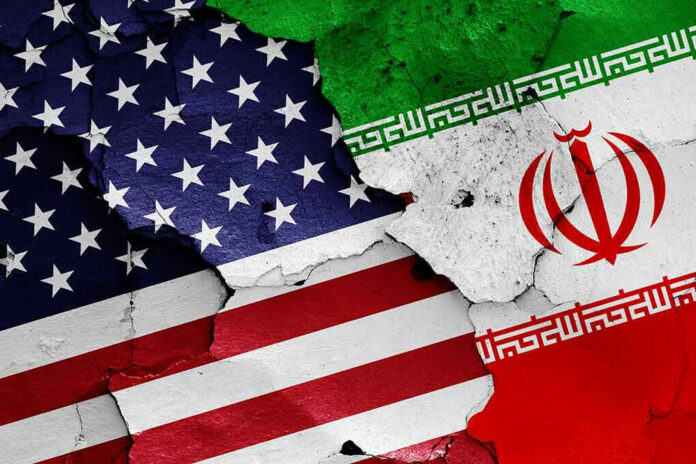
Iran’s reported shootdown of a U.S. fighter jet—and a televised bounty on the pilot—has pushed the Trump administration into the kind of escalating Middle East crisis MAGA voters thought they voted to avoid.
Quick Take
- Iran’s IRGC claims it downed a U.S. fighter over central Iran as American forces reportedly conducted a time-sensitive rescue mission.
- U.S. sources told Axios a jet was shot down and one of two crew members was rescued; the second crew member’s status remained unclear.
- Iranian state media announced a “prize” for anyone who captures the pilot alive and urged civilians to shoot at U.S. aircraft—raising the risk to any rescue effort.
- Conflicting reporting persists on whether the aircraft was an F-35 or an F-15, and Iranian “debris” photos have not been independently verified.
What is confirmed, what is claimed, and what remains unknown
Iran’s Islamic Revolutionary Guard Corps said it shot down a U.S. fighter jet over central Iran, a claim that landed in the middle of a fast-moving rescue operation. Two sources told Axios a U.S. jet was shot down, and U.S. special forces recovered one of two crew members. Officials had not publicly resolved the biggest open questions: the type of aircraft involved and whether the second crew member was captured, killed, or evading.
U.S. Central Command had denied an earlier Iranian claim the prior day, stating all U.S. fighter aircraft were accounted for. The second claim—paired with independent confirmation to Axios—left the public with a fog-of-war picture that is politically combustible at home. When Americans hear “downed pilot” and “rescue mission,” support can rally quickly, but it also raises the stakes for retaliatory strikes and deeper entanglement.
A televised bounty turns combat into a manhunt
Iranian state media escalated the incident beyond a standard military exchange by announcing a prize for anyone who could capture the “enemy pilot or pilots” alive and deliver them to police. Broadcast messages reportedly urged viewers to shoot at U.S. aircraft overhead. That call matters because it blurs the line between battlefield and civilian space, increasing the danger to any American aircrew and to U.S. personnel who might be ordered into contested territory to extract them.
From a rule-of-law perspective, it also complicates how Americans should interpret the conflict’s trajectory. A government encouraging civilians to participate in a capture effort creates a chaotic environment where propaganda, misinformation, and vigilante action can spread faster than verified facts. For the Trump White House, any rescue success could become a short-term political win, but a failed extraction or hostage situation would instantly narrow the administration’s options and intensify pressure for escalation.
The credibility gap: “largely destroyed” air defenses vs. a shootdown
The reported shootdown sits uncomfortably beside recent U.S. military messaging that Iran’s air defenses had been severely degraded. CENTCOM commander Adm. Brad Cooper had said Iran’s navy wasn’t sailing, its aircraft weren’t flying, and its air-and-missile defense systems were “largely destroyed.” If a manned U.S. aircraft was brought down anyway, that does not automatically prove U.S. assessments were wrong—but it does show the limits of public-facing claims in real-time war.
Conservatives who value competence and accountability will recognize what’s at stake here: when leaders make confident claims about an enemy’s diminished capacity, any high-profile reversal becomes a trust issue. It also changes operational risk calculations for pilots tasked with flying over defended territory. At the same time, Iranian statements about a “new air defense system” and explosive impact effects remain unverified, and Iranian-released photos of alleged debris have not been independently confirmed by U.S. outlets cited in the research.
Why this is splitting MAGA—and why the split is not irrational
Supporters of President Trump are not arguing over whether America should protect its troops; they are arguing over what protecting them requires. One camp sees deterrence: respond hard, end the threat, and prevent more downings. Another camp hears echoes of post-9/11 mission creep: initial action turns into open-ended involvement, higher energy costs, and a public asked to bankroll another long conflict while Washington promises “this time is different.” Both reactions are rooted in recent history.
What is clear from the available reporting is that the administration is now responsible for outcomes, not talking points. The incident—downed jet, partial rescue, unresolved crew status, and a public bounty—forces decisions that are far more consequential than cable-news debates. With limited confirmed details, the public should demand clarity on the basics: the aircraft type, the remaining crew member’s status, and the rules governing further strikes, especially when escalation can ripple into inflation through oil markets and broader regional instability.
Sources:
https://www.cbsnews.com/live-updates/iran-war-us-trump-warns-more-coming-oil-gas-strait-hormuz/
https://www.axios.com/2026/04/03/iran-us-fighter-shot-down