

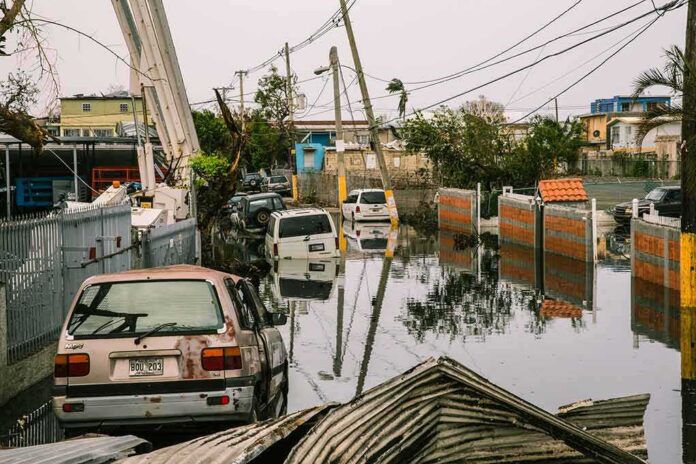
A sprawling Thanksgiving storm cut power to more than 836,000 customers and upended travel and traditions across multiple states.
Story Highlights
- More than 836,000 customers lost power at the peak as fierce winds hit several states.
- Heavy rain, high winds, and coastal flooding battered the East Coast from North Carolina to New Jersey.
- Macy’s Thanksgiving Day Parade was postponed due to wind, rain, and flooding risks.
- Air travel saw hundreds of cancellations and over a thousand delays across the holiday rush.
Powerful Winds and Widespread Outages
Reuters reported that more than 836,000 utility customers were without power by late afternoon on Thanksgiving, with large clusters in Virginia, Maryland, and Pennsylvania. Forecasters and local outlets cited wind gusts up to 70 miles per hour, strong enough to topple trees and power lines in several areas. That mechanism tracks with what we see in many severe storms: saturated soil, stressed trees, and overhead lines combine to fail under peak gusts.
The outage number came from PowerOutage.us at a specific time. That makes it a strong snapshot of scale, even if final tallies can shift as utilities restore service and refine counts. What matters for most families is simple: lights went out, fridges warmed, and heat and internet dropped on a major holiday. Many communities faced the same hard reality at once, which strained local crews and slowed restoration in the hardest hit pockets.
East Coast Flooding, Wind Damage, and Travel Disruptions
From North Carolina to New Jersey, heavy rain and strong winds lashed the coast. The New York Times reported more than half a million customers without power across that corridor, with coastal flooding on roads and in low-lying areas. Holiday travel felt the hit. Airports logged hundreds of cancellations and more than a thousand delays, forcing families to pivot plans or wait out the weather. Rail and road travel also moved slower due to ponding and crosswinds.
The storm did not stop at the coast. Reports cited significant outages in parts of the Midwest and heavy snow in some areas, adding to regional strain on crews and travelers. Missouri saw large outage totals, and Illinois also reported thousands without power, though the worst impacts were concentrated along the Eastern Seaboard. The wide footprint meant supply chains and airline schedules faced rolling headaches, even where weather cleared faster.
Parade Postponement Marks a Rare Holiday Disruption
New York officials and organizers postponed Macy’s Thanksgiving Day Parade as winds and heavy rain made conditions unsafe. Local coverage tied the decision to gusts strong enough to bring down tree limbs and create hazards along the route, including the risk to large balloons and crowded sidewalks. The parade rarely shifts. Moving it underscored how the storm turned a cherished, century-old tradition into a safety call that most New Yorkers understood.
Here is the latest detailed infographic and storm summary from our Thanksgiving 2026 Coastal storm. #mawx #riwx #ctwx pic.twitter.com/lvXWoCpQXW
— SNE Amateur Radio Skywarn (@WX1BOX) November 27, 2026
For millions of Americans, the day’s scenes felt familiar: flooded streets, grounded flights, and neighborhoods lit by generators. Climate Central’s review of outages over two decades found that most major outages link to weather, and such events have grown more common in recent years. That backdrop helps explain why a single storm can disrupt power, travel, and public events at once, and why both parties often agree that basic infrastructure resilience still lags behind the need.
Why This Matters Beyond One Storm
Storms do not check party labels. When the grid fails or airports stall, working families pay first. Many on the right see fragile systems shaped by years of underinvestment and red tape. Many on the left see inequity grow when outages and floods hit those with the least cushion. Both are responding to the same outcome: a government that struggles to harden power lines, clear dangerous trees, upgrade drainage, and modernize airports at the pace weather now demands.
Better data can sharpen decisions. Regulators track outage length and frequency, and federal energy analysts have shown rising hours without power in recent years. Local officials and utilities also learn from every event. Clear, shared standards on what counts as an outage, where lines failed, and how long repairs took can turn a messy holiday into a tighter playbook before winter peaks. Families want that focus. They expect results more than speeches.
What We Know, and the Limits
We know the storm knocked out power to hundreds of thousands, with peak winds near 70 miles per hour, and that heavy rain and flooding added to the damage. We know the East Coast bore the brunt, while parts of the Midwest faced snow and outages. We also know the parade was postponed and holiday flights were disrupted. Some totals will update as utilities finish reports, but the scale and impact of the event are clear and well documented.
Sources:
facebook.com, nytimes.com, lbc.co.uk, abc7ny.com, amp.dw.com
© boldfrontnews.com 2026. All rights reserved.