

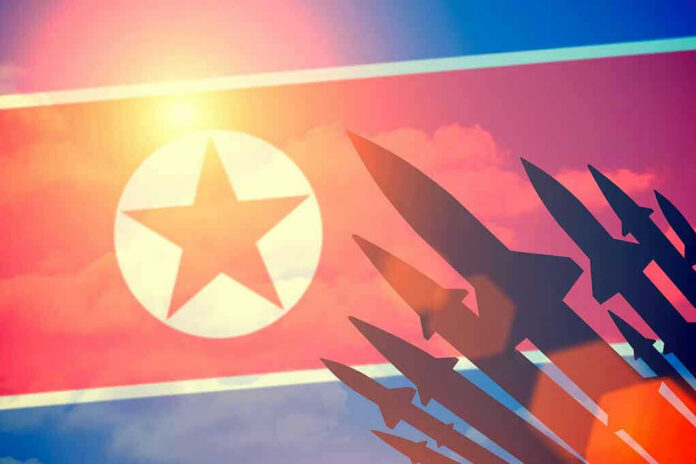
North Korea has quietly rewritten its constitution to hard‑wire an automatic nuclear response if Kim Jong Un is attacked, creating a far more dangerous world for America and its allies.
Story Snapshot
- North Korea’s new constitution concentrates nuclear authority in Kim Jong Un while enabling delegated launch in a crisis.
- State media tout the buildup as “deterrence,” but regional analysts warn it makes nuclear use more likely, not less.
- The same legal changes erase reunification language with South Korea and redefine borders, signaling permanent hostility.
- Kim vows “irreversible” nuclear status and continued expansion of warheads and missiles aimed at the United States and its partners.
Kim’s Constitutional Power Grab Over Nuclear Weapons
North Korea’s 2026 constitutional revision explicitly states that command authority over nuclear forces belongs to the Chairman of the State Affairs Commission, meaning Kim Jong Un personally holds formal legal control over every nuclear weapon in the country.[1] The same language allows him to delegate nuclear weapons use to a national nuclear warfare command organization, codifying a structured chain of command for launching a strike rather than leaving it ambiguous or symbolic.[1][2] Analysts describe this as a major tightening of Kim’s grip on the nuclear trigger, matching earlier assessments that the North Korean constitution codifies basic principles on politics, defense, and security.[3]
State media and regime narratives portray this constitutional move as a necessary step to strengthen national defense and deter what they call “hegemonic pursuits” and “gangsterlike imperialists,” terms long used for the United States and its allies.[1][2] Kim has repeatedly argued that only nuclear weapons can guarantee regime survival and national dignity, and he now embeds that doctrine in the country’s highest legal document.[1][3] For Americans, this means Washington is no longer dealing with ad‑hoc threats, but with a nuclear posture that North Korea claims is legally “irreversible” and central to its state identity.[1][2]
From Deterrence Storyline to Real Escalation Risk
North Korea insists these constitutional changes and its growing arsenal are purely defensive, claiming they are a response to foreign hostility and military exercises near its borders.[1][2] However, regional governments and independent security researchers counter that codifying an expansive nuclear doctrine and streamlining command structures increases the chances those weapons could be used in a crisis, by lowering political and procedural barriers to launch.[2] The Institute for the Study of War reports that the amendment effectively formalizes a decentralized nuclear command and control system, enabling rapid execution of Kim’s orders even if communication lines are strained or disrupted during conflict.[2]
Outside experts also place this latest amendment in a pattern going back decades, where North Korea repeatedly rewrites constitutional and legal language to expand its nuclear role while testing longer‑range missiles and more advanced delivery systems.[3] The country’s constitution already codifies national defense as a core function of the state, and successive revisions have moved steadily from vague references to military power toward explicit affirmation of nuclear weapons as the regime’s ultimate guarantor.[3] This history supports concerns that Pyongyang’s claim of “deterrence” masks a long‑term strategy to normalize nuclear coercion against the United States, South Korea, and Japan whenever it seeks sanctions relief or political concessions.[1][2]
Erasing Reunification and Locking in Permanent Confrontation
Alongside the nuclear changes, the revised constitution reportedly includes a new territorial clause that defines borders with South Korea but omits the older, more overtly hostile language and longstanding rhetoric about eventual reunification.[1] Analysts at 38 North describe this as part of a broader package that consolidates Kim’s leadership status while signaling that North Korea now treats the peninsula as permanently divided rather than aiming for unification under a single state. That shift matters for American interests, because a regime that no longer even pretends to seek peaceful reunification is freer to frame South Korea as a fixed enemy and to justify forward‑leaning nuclear deployments near the Demilitarized Zone.[2]
For your information. This was my reply to X.
Dear X support,Even though it was not pleasant to get the email saying that my X post violated the rules, I found the email very interesting for the following reasons. First of all, I see the way the Korean government puts pressure…
— KHuntington (@K_Humboldt) June 2, 2026
For a conservative American audience, this should underscore why a strong United States military, robust missile defense, and a disciplined foreign policy are non‑negotiable. North Korea is not trimming its arsenal, it is embedding nuclear weapons into its constitution, centralizing authority in a hereditary dictator, and designing legal mechanisms to keep missiles ready if leadership is threatened.[1][2] That reality demands vigilance from Washington, steady support for allies who share our values, and a clear rejection of any multilateral deals that weaken United States sovereignty or limit our ability to defend the homeland.
Sources:
[1] Web – North Korea’s Kim vows ‘exponential’ boost in nuclear forces
[2] Web – North Korea Revises Constitution, Boosts Kim’s Nuclear Authority
[3] Web – Korean Peninsula Update, May 12, 2026 | ISW
© boldfrontnews.com 2026. All rights reserved.