

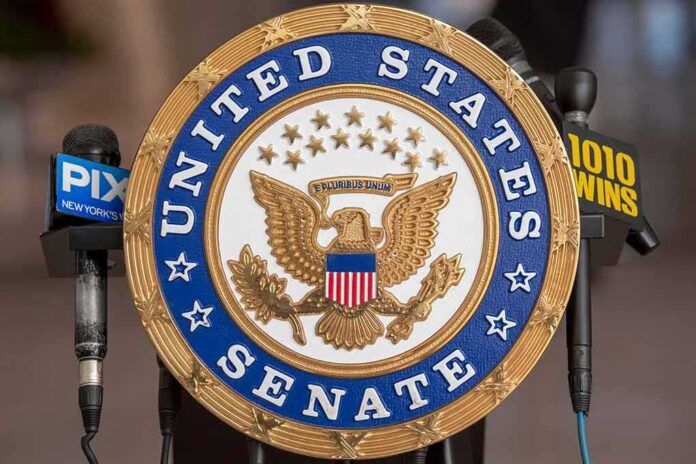
The Senate just told Democrats they won’t get to use “war powers” as a backdoor veto over President Trump’s Iran campaign—even as the fighting intensifies and Americans are already dying.
Story Snapshot
- The Senate voted 47-53 on March 4, 2026, rejecting a Democratic-led resolution that would have required U.S. forces to withdraw from hostilities involving Iran without explicit congressional approval.
- The vote comes as the Trump administration and Israel accelerate operations against Iran; reports cite more than 1,000 civilian deaths in Iran and six Americans killed.
- Republican leadership argued the president must retain operational flexibility, while Democrats argued Congress must reassert its constitutional role before a longer conflict takes hold.
- The vote featured unusual cross-party splits, including Sen. Rand Paul supporting the resolution and Sen. John Fetterman opposing it.
Senate Vote Locks In Trump’s Freedom of Action in Iran
Senators rejected the measure after sponsors argued it would force Congress to authorize any continued hostilities involving Iran. The resolution’s failure preserves the Trump administration’s ability to continue strikes alongside Israel as the conflict enters its first week. Republicans pointed to the need for speed and deterrence, while Democrats framed the vote as a test of whether lawmakers will check the executive branch before a fast-moving campaign becomes a long-term commitment.
Senate leadership dynamics mattered. Republicans hold a narrow majority, giving President Trump room to defeat resolutions that constrain the commander in chief. The roll call still showed the issue isn’t purely partisan: Sen. Rand Paul, a consistent critic of open-ended military authorities, sided with Democrats, while Sen. John Fetterman broke the other way. Those defections underscored that the fight is less about personalities than about where Congress draws the line on war powers.
What the War Powers Resolution Was Designed to Do
The 1973 War Powers Resolution was written after Vietnam-era backlash over executive overreach. It requires presidents to notify Congress within 48 hours of introducing U.S. forces into hostilities and generally limits such deployments to 60 days without congressional authorization. Democrats leaned on that framework to argue that expanding operations against Iran without a new authorization risks normalizing military action that never receives a direct vote from the people’s representatives.
Republicans countered that the law should not function as a congressional “kill switch” in the middle of an escalating conflict. That argument gained traction as the Pentagon described widening operations, including air and naval activity in and around Iranian territory. Defense Secretary Pete Hegseth publicly described the campaign as accelerating, and President Trump defended the effort as necessary against what he portrayed as decades of Iranian hostility toward the United States.
Escalation Timeline, Casualty Reports, and What’s Confirmed
Public reporting places the opening phase of the campaign around late February 2026, with U.S. strikes conducted in coordination with Israel. By March 3, the Pentagon described expanded operations and pointed to evidence of major U.S. military actions at sea. Civilian casualty reports from Iran climbed above 1,000 in some accounts, while U.S. deaths were reported at six Americans. The speed of events is fueling calls for clarity on scope and objectives.
Some claims remain unconfirmed across major outlets. One report suggested Iran’s Supreme Leader was killed early in the fighting, but that detail was not consistently corroborated in other coverage summarized in the research provided. The gaps matter because lawmakers and voters cannot measure proportionality, risk, or end state without reliable facts. In a constitutional system, speed cannot replace accountability, but accountability also depends on accurate, verified information.
House Vote Next as Congress Repeats a Familiar Pattern
A similar push was scheduled in the House for March 5, led by Reps. Ro Khanna and Thomas Massie, pairing a progressive Democrat with a limited-government Republican. Their argument emphasized Congress’s Article I responsibilities and the cost of prolonged conflict, especially after years of public frustration over overseas spending, debt, and inflation at home. Early expectations in the available reporting suggested the House effort would face long odds under GOP control.
TRUMP RETAINS UNFETTERED COMMAND OVER IRAN CONFLICT
Senator Rand Paul’s lament about a "Congress without ambition" hits home. By refusing to assert its power to declare war,Congress has essentially handed the "keys to the kingdom" to the ..
Read more : https://t.co/9JJiU2LRmA pic.twitter.com/o3Ze9sXAfi
— Update News Room (@Updatenewsroom) March 5, 2026
The larger pattern is hard to miss. The Senate previously rejected similar attempts to restrict Trump’s use of force, including after earlier Iran-related strikes and after the January 2026 Maduro operation. Supporters of the president view that consistency as stability in a dangerous world. Critics—sometimes bipartisan—see it as Congress slowly surrendering its war vote, leaving ordinary Americans to absorb the human and financial costs of conflicts that can grow faster than oversight.
Sources:
Senate rejects resolution to limit hostilities in Iran
Senate rejects war powers resolution