

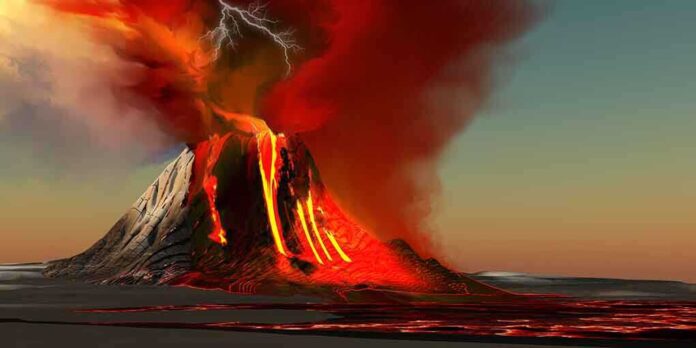
A volcano that has slept peacefully for nearly 12,000 years just violently awakened in Ethiopia, and scientists are scrambling to understand what triggered this geological giant after such an extraordinarily long dormancy.
Story Snapshot
- Ethiopian volcano erupts after remaining dormant for approximately 12,000 years
- Massive smoke plumes reached 14 kilometers (9 miles) into the atmosphere
- The Ha volcano’s sudden awakening has caught geological monitoring systems off guard
- Scientists face challenges understanding triggers for such ancient volcanic reactivation
Ancient Giant Stirs in Ethiopia’s Volcanic Landscape
Ethiopia’s northeastern region experienced a geological event of unprecedented scale when the Ha volcano roared back to life after nearly 12 millennia of silence. The Toulouse Volcanic Ash Advisory Centre confirmed the eruption, documenting massive smoke columns that pierced the sky at altitudes reaching 14 kilometers above sea level. This extraordinary awakening represents one of the longest documented periods of volcanic dormancy followed by sudden reactivation in recent geological history.
The sheer magnitude of this dormancy period puts the Ha volcano’s awakening into remarkable perspective. Most active volcanoes operate on cycles measured in decades or centuries, not millennia. When Mount Vesuvius buried Pompeii in 79 AD, this Ethiopian giant was already thousands of years into its slumber. The last time Ha erupted, human civilization was just emerging from the last Ice Age, making this reactivation a truly rare geological phenomenon.
Understanding Volcanic Dormancy and Sudden Reactivation
Volcanic dormancy lasting 12,000 years challenges conventional understanding of magma chamber dynamics and geological triggers. Most volcanologists classify dormant volcanoes as those inactive for 10,000 years or less, placing Ha in an unusual category that blurs the line between dormant and extinct classification. The volcano’s sudden reactivation suggests complex underground processes that scientists are still working to comprehend and monitor effectively.
The massive plume height of 14 kilometers indicates significant explosive force behind the eruption, suggesting substantial pressure buildup over the millennia. This altitude places the volcanic ash in the lower stratosphere, potentially affecting regional air travel patterns and weather systems. Such explosive reawakenings from extended dormancy periods often indicate fundamental shifts in underlying geological structures or external triggering mechanisms that warrant immediate scientific investigation.
Regional Implications and Monitoring Challenges
Ethiopia sits within the East African Rift System, one of Earth’s most geologically active regions where tectonic plates slowly separate and create volcanic activity. The Ha volcano’s location in this tectonically dynamic area suggests its reactivation might signal broader geological changes affecting the entire rift system. Regional seismic networks likely detected precursor activity, though the extended dormancy period meant limited historical data for comparison and prediction models.
The eruption poses immediate challenges for local populations and regional infrastructure, particularly regarding air quality and potential ashfall patterns. The 14-kilometer plume height suggests ash dispersion across significant distances, potentially affecting agricultural areas and urban centers depending on prevailing wind patterns. Monitoring stations throughout the region must now recalibrate their volcanic threat assessments to account for this previously quiet geological feature becoming an active concern for regional safety and economic planning.
Sources:
Ethiopian volcano stirs to life after 12000-year silence